
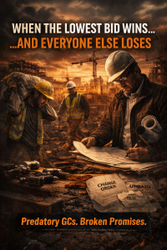
When the lowest Bid Wins....And Everyone Else Loses
Posted by Pinch Estimating on Jan 12th 2026

When the Lowest Bid Wins… And Everyone Else Loses
The Harsh Reality of Predatory General Contractors Who Leave Subs Paying the Price
In construction, everyone knows the mantra: “Time is money, and money is profit.” But too often, this logic gets twisted by general contractors (GCs) who seem to have mastered the art of profit at everyone else’s expense.
It starts with the lowest bidder mentality.
A GC posts a project, opens it to multiple subcontractors, and almost always selects the cheapest option. On paper, this seems smart — cost savings for the owner, efficiency for the project. In reality, it sets off a chain reaction of delays, disputes, and financial strain for the people actually building the project.
The Domino Effect of Choosing Only the Lowest Bids
When a GC prioritizes price over capability:
- Subcontractors are forced to cut corners just to stay competitive.
- Schedules slip as inexperienced crews struggle with complex tasks.
- Quality suffers, leading to punch lists, rework, and claims.
The kicker? The GC rarely bears the consequences. By hiding behind waivers of subrogation, insurance clauses, and contractual language, they insulate themselves from risk while the subs and trade workers absorb the financial and operational fallout.
Change Orders: The Broken Promise Machine
Even when subs identify legitimate scope changes or unexpected conditions and submit change orders, they often see little to no payout.
Instead, the GC might:
- Verbally approve the change order but delay formal signatures.
- Promise “future work” instead of immediate payment.
- Exploit subcontractor dependence on ongoing projects to keep them at bay.
The result? Labor, materials, and overhead costs come out of the subcontractor’s pocket, while the GC maintains the illusion of fairness.
Why Subcontractors Keep Playing the Game
Many subs keep working with predatory GCs because:
- They need continued access to work for cash flow.
- They hope the promised “next project” will balance out past losses.
- Legal action or contract enforcement is costly and time-consuming.
In short, the system is designed to reward patience, not justice.
How the General Contractor Shields Themselves
- Waiver of Subrogation: Prevents insurance from holding the GC accountable, passing risk down to the subcontractor.
- Ambiguous contracts: Language that makes it hard to enforce change orders, scope adjustments, or quality disputes.
- Promise-based leverage: GCs keep dangling future projects, delaying payment indefinitely.
The True Cost
Who pays in the end?
- Subcontractors: Lose money, take on risk, and burn valuable labor hours.
- Workers: Experience delays, poor work environments, and sometimes unpaid overtime.
- Project Owners: End up paying more for rework, delays, or replacements.
And the GC? Profit intact. Risk mitigated. Reputation largely protected.
Protecting Yourself as a Subcontractor
- Document everything — emails, change orders, field instructions.
- Insist on written approvals for all scope changes.
- Negotiate contracts carefully — watch for waivers of subrogation, ambiguous payment clauses, and scope definitions.
- Limit dependency on one GC — diversify your client base to maintain leverage.
- Escalate strategically — involve legal counsel or insurance brokers if large sums are at stake.
Final Thoughts
The lowest-bid-first mentality may win contracts for GCs in the short term, but it erodes trust, quality, and fairness across the project.
Predatory practices like withholding change orders, hiding behind waivers, and dangling future work as leverage hurt everyone except the GC.
For subcontractors, the lesson is clear: know your rights, document everything, and don’t let promises replace payment.