
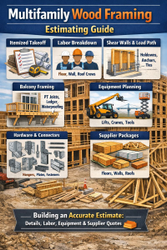
How Multifamily Wood Framing Is Estimated (The Real-World, Itemized Takeoff + Equipment + Supplier Guide)
Posted by Pinch Estimating on Jan 26th 2026
?️ How Multifamily Wood Framing Is Estimated
The Real-World, Itemized Takeoff + Equipment + Supplier Guide
If you’ve ever priced wood framing on a multifamily build and felt like “the studs are easy but the number still gets away from me,” you’re not imagining things.
Multifamily wood framing estimating is not about counting studs.
It’s about correctly capturing:
- structural requirements that live on the S sheets (not the A sheets),
- the “details” that multiply labor and hardware,
- exterior exposure (balconies, PT, coatings),
- and the equipment + sequencing that makes the framing plan actually buildable.
This blog is an exhaustive, itemized, super explainitory guide on how to estimate and quantity takeoff multifamily wood framing, including the equipment you need, how suppliers quote it, and the exact categories that commonly get missed.
The Core Rule of Multifamily Framing Estimating
Studs are cheap. Details are expensive.
On multifamily, your biggest misses usually come from:
- Hardware
- Blocking
- Balcony framing
- Shear walls
- Engineered lumber
- Waste factors
- Fire stopping framing
Not studs.
Step Zero: Know Which Sheets Actually Control Framing
You never get everything from one sheet. Multifamily framing is spread across:
Architectural (A sheets) — geometry, layout, openings
Typical places:
- A1.xx Floor plans (all levels)
- A2.xx Wall type plans
- A4.xx Enlarged plans (stairs, balconies, cores)
- A5.xx Sections/details
- Door and window schedules
You use these for:
- where walls are,
- how long they are,
- wall heights (via sections),
- and where openings exist.
Structural (S sheets) — sizes, loads, connections, shear
- S1.xx Foundation plans
- S2.xx Framing plans (floor/roof) + shear wall plans
- S3.xx Details
- S4.xx Schedules (shear schedules, header schedules, beam schedules)
- S5.xx Connection diagrams / load path diagrams
You use these for:
- joist sizes + spacing,
- beam sizes and ply counts,
- shear wall types and nailing,
- hold-downs, anchor rods, continuous ties,
- and hardware model requirements.
General notes + specs — what gets missed
- Cover sheet (G0 / A0)
- Structural notes
- Division 06 in project manual (if provided)
You use these for:
- PT grade/treatment level,
- sheathing thickness/grade,
- nail sizes and patterns,
- coatings (ZMAX/HDG/stainless),
- and required fire stopping language.
Key reality: Structural always overrides architectural.
The Professional Takeoff Workflow (How Seniors Don’t Miss Things)
If you want a clean estimate, you take off in this order:
- Concrete interface / PT package
- Floor framing system
- Wall framing (interior + exterior)
- Structural wall components (shear, drag, collectors, ties)
- Roof framing
- Stairs & landings
- Balconies / exterior framing
- Shaft walls / party walls
- Sheathing package
- Hardware & connectors (with a matrix)
- Misc framing (allowances, waste, consumables)
- Labor by phase (separate buckets)
- Equipment schedule by phase (don’t guess)
Also: in takeoff software, build dedicated layer groups early. Example:
- PT Plates / PT Rim / Anchors / Sill Seal
- Floors: Joists / Beams / Rim / Subfloor
- Walls: Plates / Studs / Headers / Blocking / Backing
- Shear: SW1/SW2/SW3 / Nailing / Edge blocking / Hold-downs / Rods / Ties
- Roof: Trusses/Rafters / Ridge / Valleys / Fascia / Sheathing / H-clips
- Balconies: Balcony Type A/B/Juliet / Ledger / PT / Waterproof sheathing / hardware
Trace once, reuse many times (walls traced once can generate plate LF, anchor counts, sill seal LF, etc.).